Branco Weiss Fellow Since
2026
Research Category
Organic chemistry, molecular design, nanoscience, molecular materials, surface chemistry
Research Location
CiQUS-Universidade de Santiago de Compostela
Background
Many of today’s most advanced molecular materials rely on chromophores – light-absorbing molecules whose stability and electronic properties make them useful in technologies ranging from photovoltaics and sensors to catalysis and photomedicine. Among the most versatile are phthalocyanines, highly robust molecular frameworks that have been studied for decades. Yet their very stability also imposes a limitation: once synthesized, their structures are difficult to modify without restarting the entire synthetic process. At the same time, aryne chemistry has emerged as a powerful tool for constructing complex aromatic systems through the controlled generation of highly reactive intermediates. Despite their complementary strengths, these two fields have never been successfully combined. Recent advances in molecular synthesis, spectroscopy, and single-molecule characterization now create an opportunity to bridge this gap and rethink how functional molecules can be designed.
Details of Research
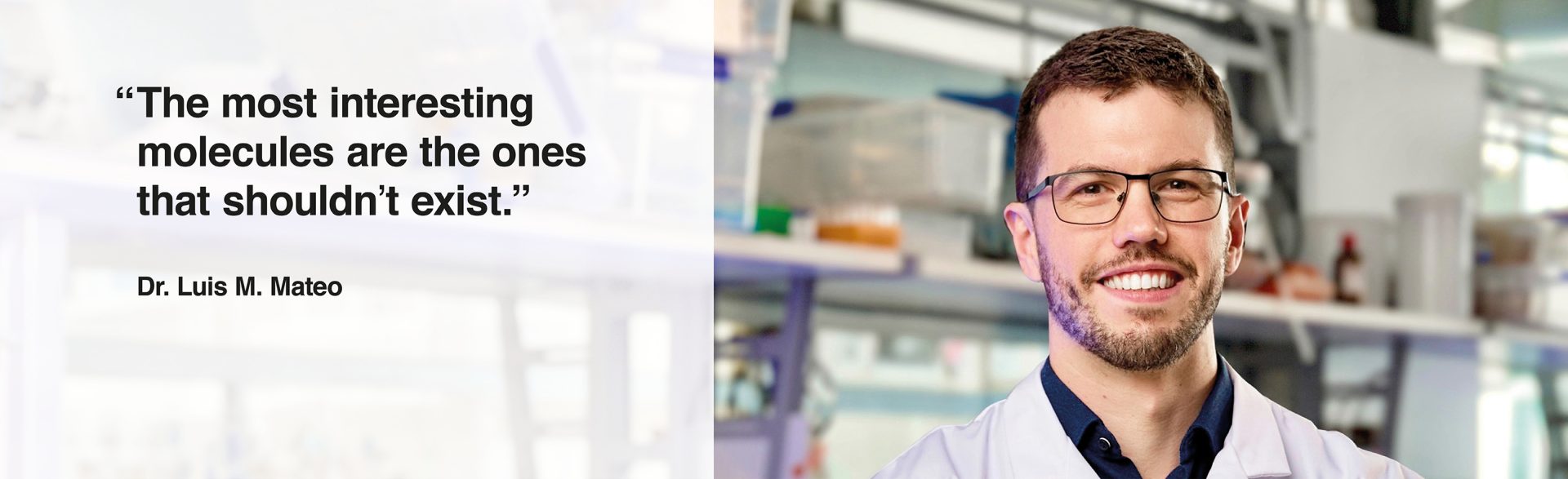
Luis M. Mateo’s project, PhthalocyanYnes, seeks to transform phthalocyanines from chemically inert chromophores into programmable molecular platforms. He will develop synthetic methods that allow reactive aryne intermediates to be generated directly within a phthalocyanine framework, enabling controlled molecular editing at a late stage of synthesis. The project combines solution-phase synthesis, advanced spectroscopy, mass spectrometry, computational modelling, and single-molecule characterization. By establishing the first phthalocyanine-centered aryne chemistry, Mateo aims to create asymmetric phthalocyanine–nanocarbon hybrids, extended molecular lattices, and graphene-like architectures with tunable optical, electronic, and magnetic properties. Even if some of the highly reactive intermediates prove difficult to access, the work is expected to provide fundamental insights into molecular reactivity and establish new principles for the design of functional molecular materials.